

Curriculum design for STEM education must seamlessly integrate improvised mini-tools and toys to foster scientific temper at primary grades, suggests research
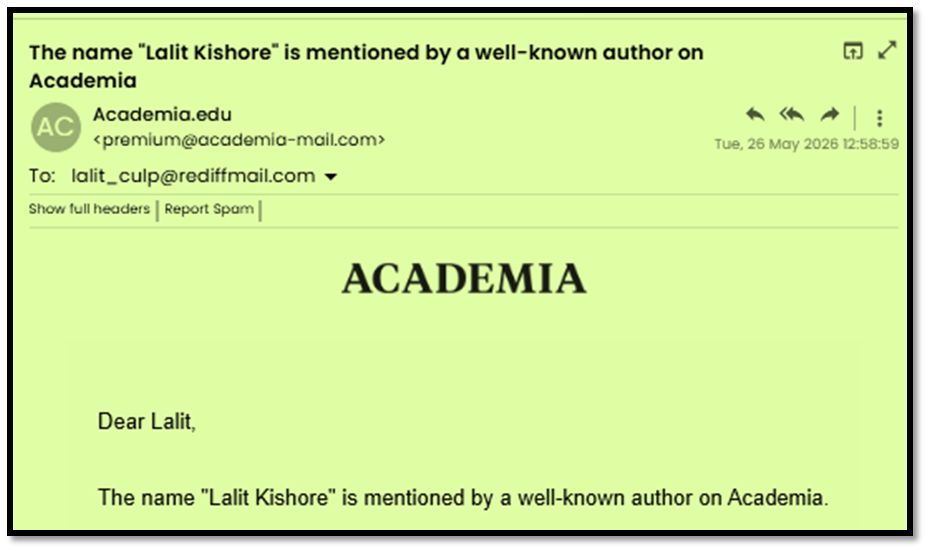
Academia.edu informed on May 26, 2026, via e-mail premium@academia-mail.com that the name "Lalit Kishore" is mentioned by a well-known author on their website which prompted Google AI search to get more details and get new citations and references.
The Google AI prompt prompt 'Write the summary of the paper: teaching marginalized children at primary schools: teachers professional development through collaborative action research' by Abdullah Haruna along with its bibliographic reference, informs that Abdullah Haruna’s study demonstrates that Collaborative Action Research (CAR) acts as a vital professional development tool to enhance teaching methodologies and improve educational outcomes for marginalized primary school children. By promoting inquiry-based learning, CAR increases teacher confidence and improves student engagement, moving away from standardized methods toward context-aware instruction. There are many alternative strategies of teaching primary science, such as, teaching science using toys (Kishore, 2009).
Lalit Kishore’s research on micro-science strategies highlights the effectiveness of low-cost, toy-based, and hands-on pedagogy in resource-limited, small-school environments. For STEM education researchers, the findings suggest that shifting toward local, play-responsive tools can effectively bridge equity gaps and demystify abstract scientific concepts. These approaches indicate that scalable, high-impact STEM education is achievable without significant financial investment in traditional laboratories, informs Google AI prompt '
The AI search adds, "Lalit Kishore’s research on "Stepping into science in small schools" offers valuable implications for STEM education:Resource Equity: It proves that inquiry-based learning is viable in under-resourced or small schools using cost-effective, everyday materials.Active Learning: It emphasizes replacing rote learning with hands-on, toy-based physics and chemistry demonstrations. The curriculum design for STEM education must seamlessly integrate improvised mini-tools to foster scientific temper.
References
Haruna, A. Teaching marginalized children at primary schools: teachers professional development through collaborative action research. You can access the document through Academia.edu.
Meerah, T. S. M. et. al (2021). Teaching marginalized children at primary schools: teachers professional development through collaborative action research. Cypriot Journal of Educational Sciences, 2 (2011) 49-60, www.world-education-center.org/index.php/cjes
Kishore, L. (2009). Stepping into science in small schools: Together with tools, techniques and toys. Proceedings: International Conference to Review Research in Science,


Comments