

Process based physics instruction coupled with concept attainment model leads to quality physics education

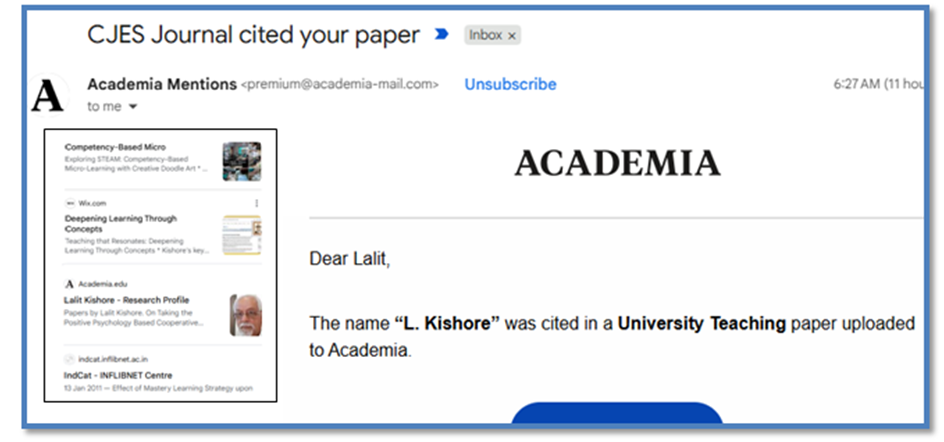
Subsequent to being informed about this blogger's mention by Academia (see inset clip) in physic education paper, an AI search (Google 2026) informed, "Dr. Lalit Kishore is an Indian educator and researcher who championed Nuffield Physics as an experimental, process-based approach to replace traditional, lecture-heavy teaching methods".
Kishore's Core Philosophy on Physics Education
• Process-Based Learning: Dr. Kishore argues that physical sciences are best learned through active inquiry, hands-on experimentation, and demonstrations rather than abstract theorization.
• Critique of Lectures: He highlights that traditional classroom lectures make physics feel remote, difficult, and disconnected from reality.
• Low-Cost and Micro-Science: He advocates for using everyday materials, simple models, and low-cost experiments to foster a scientific temper, especially in resource-constrained settings.
Kishore's Nuffield Physics Connection:
1. The Mayo College & Nuffield Physics Connection
• Physics Master (1971–1975): Dr. Lalit Kishore taught physics at Mayo College, Ajmer, for a major part of his 15-year career in school education.
• Pioneering Nuffield Physics: During his tenure at Mayo College in the early 1970s, he formally implemented the British Nuffield Physics innovation. He treated physics purely as an experimental science, steering students away from traditional lectures.
• Acclaimed Academic Papers: Based directly on his practical experiences teaching the Nuffield framework at Mayo College, he published several landmark research papers. Notably, four of his papers were featured in the UK-based journal School Science Review by the Association for Science Education, and several others appeared in NCERT's flagship journals.
2. Pedagogy and Educational Philosophy
• Concept Attainment Model (CAM): Dr. Kishore is heavily recognized for blending Nuffield's experimental nature with Jerome Bruner's Concept Attainment Model. This inductive approach teaches physics using positive and negative experimental examples, prompting students to deduce scientific rules themselves.
• Low-Cost Science Experimentation: He became a massive proponent of creating "no-cost and low-cost" scientific laboratory equipment to democratize practical physics. NCERT's Central Institute of Educational Technology actually produced 25 video films detailing his low-cost physics experiments, earning him a National Award from the Department of Science and Technology (DST).
• Authorship: He authored foundational text guides for educators, including the widely cited book "Teaching of Physical Science".
Google Scholar +1
3. Connection to RIE Ajmer
His localized research paper titled “Teaching Science to Young Children”—which heavily championed this process-based, inquiry-driven style of physics instruction—was published directly in The Educational Trends, an academic journal published by NCERT's Regional Institute of Education (RIE), Ajmer.
He worked as visitin fellow on Summer Insitutes on Physics for three years (1973-75) for training of physics educators on Nuffield Physics while working as Physics Master at Mayo College, Ajmer, deputed by Mr SR Das, then principal of the institution.
Reference
Google (2026, October 1). dr lalit kishore on physics education and nuffield physics. https://www.google.com/search?q=dr+lalit+kishore+on+physics+education+and+nuffield+physics&oq


Comments