

World Population Day: Bringing Population Wisdom Back to Schools
World Population Day, observed annually on July 11, is being celebrated with the theme "Realizing the hopes and aspirations of young people – today and for the future"to raise awareness about global population dynamics, reproductive health, and sustainable development. As of July 2026, the global population is estimated to be approximately 8.3 billion people, states the UN.
This year observance places a strong emphasis on youth empowerment and the reproductive choices of young adults.Global Population:.Key Demographics: India is the most populous country with over 1.47 billion people, followed by China and the USA.
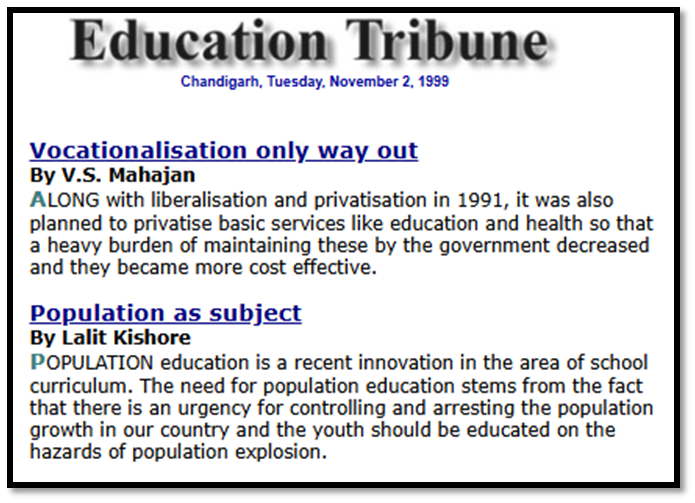
Instead of just celebrating the day as an event, there is a need to revive the Poulation Education Project of the NCERT evolved in 1990s. This blogger had contributed an article "Population Education" which was published in The Tribune on November 2, 1999. (www.tribuneindia.com/1999/99nov02/edu)
An AI accesss to the article revealed, "Dr. Lalit Kishore, a Jaipur-based educator and researcher, frequently contributed to The Tribune India on subjects like population education and science curricula. His writings emphasized introducing population education early on to help students comprehend how demographic changes impact the environment and society."
Key Concepts from Dr. Kishore's Work as reported by the Google AI were as follows..
Focus: Dr. Lalit Kishore's articles published in the The Tribune focused on the integration of population awareness into school curriculums.
Innovation: Population education is a necessary and modern innovation to make the student population aware of the rapid changes taking place in their surroundings.
Environmental Impact: Understanding population dynamics is vital for addressing the root causes of resource depletion and environmental de-gradation.
Socio-economic Awareness: Teaching students about population size, growth, and distribution helps them grasp broader developmental and societal challenges.“
The article is available at https://www.tribuneindia.com/1999/99nov02/edu.htm#2
Population as subject
By Lalit Kishore
POPULATION education is a recent innovation in the area of school curriculum. The need for population education stems from the fact that there is an urgency for controlling and arresting the population growth in our country and the youth should be educated on the hazards of population explosion.
Today’s student will be tomorrow’s parent and they need to be made aware of population problems and importance of small family. Similarly, a UNESCO report also urges educational institutions in all countries to expand their curricula to include a study of population dynamics and policies, including where appropriate responsible parenthood and the role of population dynamics to socio-economic development and international relations.
Population education deals with present-day population problems and its demographic consequences. It aims at making children aware of the causes and consequences of uncontrolled fertility with stress on developing positive attitudes towards planned parenthood among them. Mr D.R. Ganesan defines population education as an attempt to engender in the mind of students awareness of their demographic predicament.
In India, the movement of population education started in 1969 with a national-level seminar on population education in Bombay. Soonafter, a Population Education Cell was set up at the National Council of Educational Research and Training (NCERT), Delhi. The NCERT set out on the work of developing population education curriculum and related instructional material. As a result of the NCERT efforts, the instructional material of the NCERT was incorporated in the curriculum of the teachers’ training courses in 30 universities.
Besides this, the NCERT trained teachers in the use of instructional material in schools. But the course was not incorporated in the school curriculum till recently.
The instructional material on population education prepared by the SCERT, New Delhi, has been integrated into the Social Sciences and Life Sciences curricula up to Class X of the Central Board of Secondary Education. Now, population education has become integral to classroom instruction in Delhi and it is sincerely hoped that other states will follow suit. It is a programme worth implementing at the national level.
With the launching of the District Primary Education Programmes (DPEP) in various states in the nineties for universalisation of primary education, the population education component can be integrated with the curriculum of environmental studies. The Lok Jumbish Project in Rajasthan has already taken the initiative in providing about 10 per cent space to population education in their environmental studies curriculum. The component of health education has been taken as the vehicle for creating awareness of population issues at the primary level by the Project.
The best way to introduce population education at the primary education level is to integrate and infuse population issue in the environmental studies curriculum.


Comments