

Capturing STEM Education: Bringing Classroom Research to Life Through Digital Photography
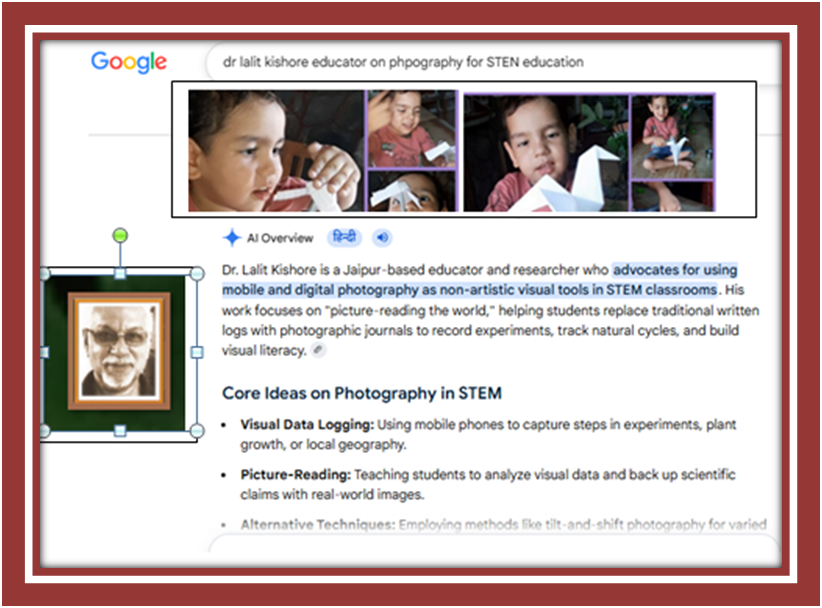
As we observe the World Photography Day today (19 August), here is the information for the teachers, educators and researchers to orient themselves in visual action research.
An AI prompt (Google 2026, August 19) informs that Dr Kishore advocates for using mobile and digital photography as non-artistic visual tools in STEM classrooms. His work focuses on "picture-reading the world," helping students replace traditional written logs with photographic journals to record experiments, track natural cycles, and build visual literacy. (See inset clipping and refer https://www.google.com/search?q=how+photography+can+work+as+a+STEM+education+tool+at+school+level&oq
Kishore's core ideas on use of photography in STEM education are as follows.
Visual Data Logging: Using mobile phones to capture steps in experiments, plant growth, or local geography.
Picture-Reading: Teaching students to analyze visual data and back up scientific claims with real-world images.
Alternative Techniques: Employing methods like tilt-and-shift photography for varied perspectives and photo-stories with descriptive captions.
Action Research: Integrating digital visual media—such as photos, infographics, and short videos—into inclusive classroom research.
Kishore further supports the notion of visual action research, indicating that a smartphone camera can serve as a valuable resource for classroom instruction and for creating a visual narrative of the lessons. Visual action research photography refers to the organized use of photographs depicting classroom activities to collect, analyze, and share qualitative data with the goal of improving teaching practices, as well as producing illustrated action research papers for academic and professional purposes. Instead of solely focusing on artistic photography, teachers and educators, in their role as action researchers, utilize photography as a practical means to document processes, behaviors, material cultures, and environmental changes, and to gain insights through reflection and strategic planning.


Comments