

Go for value-oriented classroom instruction rather than teaching values as a separate subject: Book
Updated: Jun 13
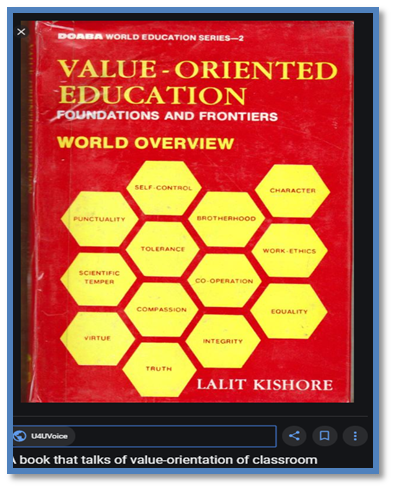
Book Review of Value-Oriented Education: Foundations and Frontier –World Overview” on Jul 31, 2019 at citizen journalism site u4uvoice , says that in Dr Lalit Kishore’s book , “The instructional strategies like experiential approach; value-clarification technique; total atmospheric approach; value-sheet method; role playing method; case method; attitude development technique, and integrated concurrent approaches have been discussed which are suitable for transaction of the subject content along with acquisition of in-built values.” It has been said that it is a book that talks of value-orientation of classroom teaching rather than value education as separate subject. The ten chapters of the book published by Doaba House, Delhi, are Value Crisis; On Making Education Value-Functional; Process of Acculturation; Definitions and Classification of Values; Strategies for Value-Orientation, Democratic Values and Education, etc.
Write a summary of book in 500 word 'Value-Oriented Education: Foundations and Frontier –World Overview' by dr lalit kishore A Google AI Overview informs "Dr. Lalit Kishore’s Value-Oriented Education: Foundations and Frontiers – World Overview examines global educational frameworks, advocating for a holistic approach that merges ethical development with modern skill acquisition. The book outlines pedagogical strategies, such as experiential learning and integrated curricula, to foster civic responsibility and combat ethical decline." The Google AI prompt (2026, June 12} "Write a summary of book in 500 words 'Value-Oriented Education: Foundations and Frontiers –World Overview' by dr lalit kishore" provides the following information [1] Value-Oriented Education: Foundations and Frontiers – World Overview" by Dr. Lalit Kishore is a seminal text that advocates for integrating moral, social, and spiritual dimensions into formal schooling. The book addresses the contemporary crisis of the global educational architecture, noting that while technical literacy and material knowledge have risen, ethical grounding has sharply declined. Dr. Kishore presents a comprehensive framework to transform education from a system of commercialized memory testing into a lifelong process of character building. For the core foundations of value education, the text outlines three fundamental pillars that underpin a robust value-based curriculum:
Philosophical Pillar: Connecting education to universal human truths, aesthetics, and common heritage.Psychological Pillar: Nurturing balanced emotional states, self-awareness, and personal focus. Sociological Pillar: Fostering responsible citizenship, civic duty, and intercultural respect.Dr. Kishore emphasizes that "true learning" must move far beyond data collection. It must consciously train the hand to work, the mind to evaluate, and the heart to empathize with societal needs. Emerging Frontiers and Methodology: A significant portion of the book explores the practical application of values across varied instructional settings. The author warns against treating morality as an isolated academic subject. Instead, he advocates for an integrated pedagogy where ethical values are naturally woven into mainstream mathematics, languages, and sciences.
Dr. Kishore also identifies teachers and parents as the primary catalysts for institutional reform. He pushes for modern teacher education programs that emphasize value-oriented training. This prepares educators to serve as moral role models rather than mere information dispensers. He also calls for the strategic use of arts, crafts, and reflective tools—like school-based quiet zones or meditation cells—to enhance student concentration and self-reflection.The Global Perspective
The "World Overview" dimension anchors the text globally by synthesizing international educational declarations, human rights treaties, and traditional philosophies. The book juxtaposes localized cultural traditions with broad global objectives, highlighting insights from the United Nations and iconic thinkers like Swami Vivekananda and Mahatma Gandhi. Dr. Kishore argues that as technological progress shrinks physical distances, humanity requires an urgent upgrade in global conscious empathy. Without a unified framework centered on peace, tolerance, and sustainable development, global technical societies face fractured isolation In summary Kishore (2026) reflects that the core thesis of the commentary on the book is that value education must be integrated seamlessly into daily classroom pedagogy rather than isolated as a separate academic subject. Teaching values in dedicated periods often reduces deep moral concepts to mere rote learning or compliance, failing to instil genuine character development. the pitfalls of isolated subject teaching is that it leads to superficial engagement of the students by treating values as a standard syllabus encourages students to memorize rules for exams without internalizing them. Furthermore, it leads to fragmented Understanding: Separation creates an artificial boundary between academic intelligence and daily human ethics. On the other hand benefits of integrated instruction results into natural inculcation of the values embedded into standard academic disciplines create authentic context, making the moral lessons practical and intuitive. furthermore, blending ethics with standard curriculum unlocks the cognitive, psychomotor, and affective learning domains simultaneously. Also, merging morality with social relations, codes of conduct, and peer discussions fosters a respectful educational ecosystem. (Kishore, 2026)
Kishoe, L. (2026, June 12). Go for value-oriented classroom instruction rather than teaching values as a separate subject: Book, lalit culp, https://lalitculp.wixsite.com/website/post/go-for-value-oriented-classroom-instruction-rather-than-teaching-values-as-a-separate-subject-book


Comments