

International Children's Book Day: Big Books at the Foundation Stage of Education Advocated by Local Educator

International Children's Book Day (ICBD) is celebrated every year on April 2nd to foster a passion for reading and showcase children's literature. Sponsored by IBBY, it aligns with Hans C Andersen’s birthday. The theme for 2026 is "Plant stories and the world will bloom." On its official website, you can find a special poster, a message, and various activities for schools and libraries around the globe.
Established in 1967 by the International Board on Books for Young People (IBBY), this day aims to promote global understanding through children's books and encourage reading via author visits, library events, reading competitions, and book-sharing, all with a focus on literacy for every child.
In India, the National Education Policy (NEP) 2020 emphasizes the foundational stage of education (ages 3–8, preschool-Grade 2) by prioritizing play-based, discovery-driven learning instead of rote memorization. Books and learning materials should be reimagined as interactive tools, highlighting bilingual approaches, mother tongue instruction, and high-quality, engaging book and non-book resources that build literacy, numeracy, and cognitive skills, along with cultural learning and the acquisition of life skills.
In the light of the foregoing, this blogger has been advocating culturally relevant bi-lingual big book for kids at the foundations stage for cultivating interest in books along with learning basic vocabulary as part of structed social learning in the schools and homes.
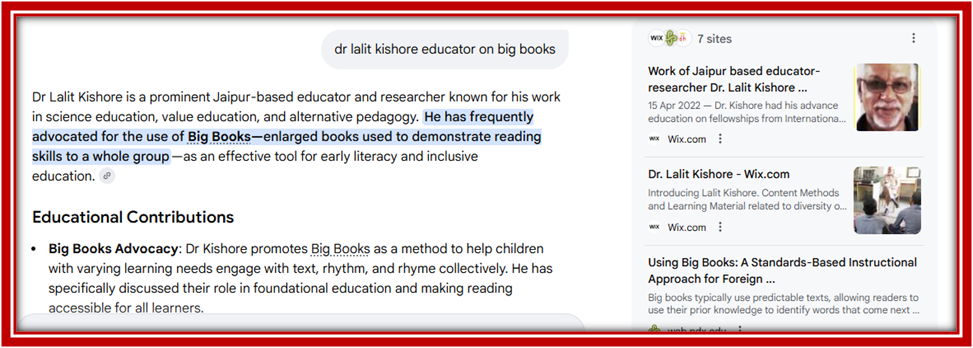
Advocacy effort is being produced as follows from prompt ' to Google AI.
Dr Lalit Kishore is a prominent Jaipur-based educator and researcher known for his work in science education, value education, and alternative pedagogy. He has frequently advocated for the use of Big Books—enlarged books used to demonstrate reading skills to a whole group—as an effective tool for early literacy and inclusive education. He promotes Big Books as a method to help children with varying learning needs engage with text, rhythm, and rhyme collectively. He has specifically discussed their role in foundational education and making reading accessible for all learners.


Comments