

Rural primary STEM education through toys, mini tools and techniques is plausible, suggests research
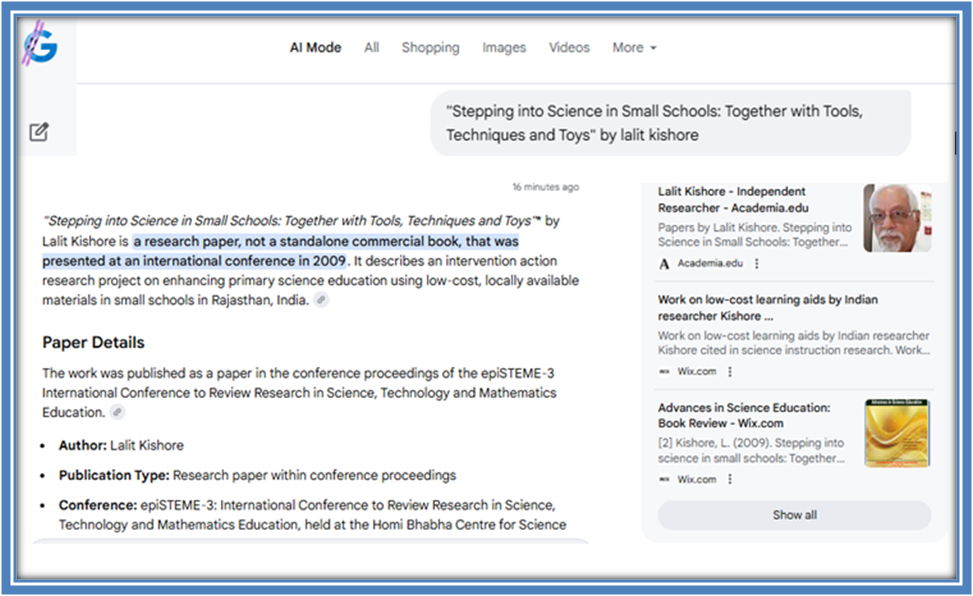
A Google AI search on the paper “Stepping into Science in Small Schools: Together with Tools, Techniques and Toys" by Lalit Kishore provides the following summary of the research work of the Jaipur based STEM educator and researcher as author.
It is informed that the research paper, not a standalone commercial book, that was presented at an international conference in 2009. It describes an intervention action research project on enhancing primary science education using low-cost, locally available materials in small schools in Rajasthan, India.
Paper details by AI are as follows
· The work was published as a paper in the conference proceedings of the epiSTEME-3 International Conference to Review Research in Science, Technology and Mathematics Education.
· Author: Lalit Kishore
· Publication Type: Research paper within conference proceedings
· Conference: epiSTEME-3: International Conference to Review Research in Science, Technology and Mathematics Education, held at the Homi Bhabha Centre for Science Education (HBCSE) in Mumbai, India
· Publication Year: 2009
· Core Idea: The paper describes the development and implementation of primary science education strategies using simple, low-cost tools, techniques, and toys to improve learning outcomes in under-resourced schools.
· Impact: The research was cited in the Journal of Higher Education Research Disciplines for its innovative approach to using inexpensive materials for science demonstrations.
AI Over View further informs the following about the the availability. Since this is a research paper published as part of conference proceedings, it is not typically available as a standalone book for purchase through conventional retailers.
1. Academic Access: The paper is available through academic repositories and platforms like Academia.edu [1] and the HBCSE website [1], often as a PDF download.
2. Citation: The paper is formally cited in other academic works, confirming its status as a piece of research literature.
3. For direct access, you would likely need to find the full proceedings online via an academic search or the specific institutional websites mentioned.


Comments