

Suitability of low-cost materials and toys based micro-science as scalable equalizer in education at early childhood stage
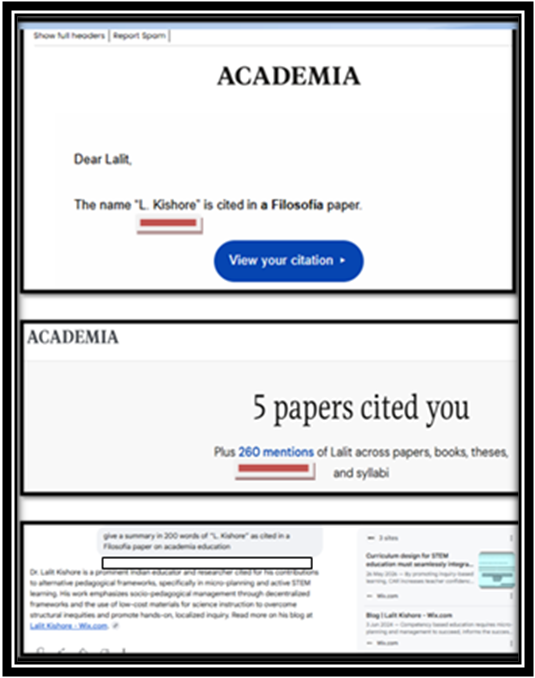
The Google AI prompt subsequent to the intimation by Academia education "give a summary in 200 words of “L. Kishore” (2026, June 15) as cited in a Filosofía paper on academia education" indicated that the researcher is known for his contributions to alternative pedagogical frameworks, specifically in micro-planning and active STEM learning. His work emphasizes socio-pedagogical management through decentralized frameworks and the use of low-cost materials for science instruction to overcome structural inequities and promote hands-on localized inquiry.
Kishore advocates a toy-based, hands-on micro-science pedagogy designed to bring inquiry-based STEM education to resource-constrained and rural schools. The approach utilizes everyday materials, micro-scale reagents, and improvised tools to democratize science education, fostering conceptual mastery and active engagement among learners. By transforming abstract concepts into interactive play, micro-science serves as a cost-effective, scalable equalizer in education, reports another AI prompt "write a summary in 200 words of the paper Stepping into Science in Small..." by Lalit Kishore in the light of significance of micro science"
In Conclusion
Kishore (2026) argues that resource-constrained schools can successfully deliver quality STEM education. He proposes a micro-science strategy that utilizes everyday household items, recyclable materials, and affordable kits instead of expensive laboratory infrastructure. This hands-on, play-responsive pedagogy shifts early childhood instruction away from rote memorization toward inquiry-based learning. According to Kishore, substituting traditional tools with local toys and small-scale items bridges equity gaps and builds a foundational scientific temper early in life. The safety benefits are significant, as smaller resource quantities minimize the risk of spills, fumes, or environmental waste. Crucially, the work positions this framework as a scalable educational equalizer. It democratizes scientific learning, fosters critical thinking, and supports gender equity by establishing inclusive environments that build student self-belief. Ultimately, the post highlights that impactful, experiential science learning is highly achievable without substantial financial investments.
Reference
Kishore, L. (2026, June 15). Suitability of low-cost materials and toys based micro-science as scalable equalizer in education at early childhood stage. Lalit Culp. https://lalitculp.wixsite.com/website/post/suitability-of-low-cost-materials-and-toys-based-micro-science-is-scalable-equalizer-in-education-at


Comments