

Using mobile photography of shift-and-tilt as non-artistic visual medium for STEM education
Mobile phone photography can be a strong tool for enhancing Science, Technology, Engineering, and Mathematics (STEM) literacy by helping students to "picture-read the world." By analyzing or creating images, students develop essential visual literacy, learn to make observations based on visual data, document scientific processes, and cultivate a critical perspective on visual or media communications. Incorporating photography into STEM education helps connect abstract concepts that are often overlooked with tangible reality.
The practice of using mobile photography for STEM literacy can revolutionize learning through various pathways for scientific observation and documentation. For starters, storyboard-based mobile photography can be utilized to record visual data. Rather than relying on traditional written STEM reports, students can engage in photographic journaling to document events, processes, and experiments, track biological growth by photographing plant life cycles, or map geological formations. Additionally, capturing the steps of an event, experiment, or investigation encourages students to slow down, closely observe details, and visually support their scientific conclusions.
To enhance STEM literacy, tilt-and-shift photography can be employed to gain insights into visual data recording through photo-stories that include captioned narratives in the form of long or wide shots, mid-shots, and close-ups for detail. By using mobile devices as tools for visual data recording and labeling photographs in relation to text data or picture-reading exercises, students can create resources for future use in the context of STEM education. The application of mobile photography for STEM literacy is considered a non-art use of art.
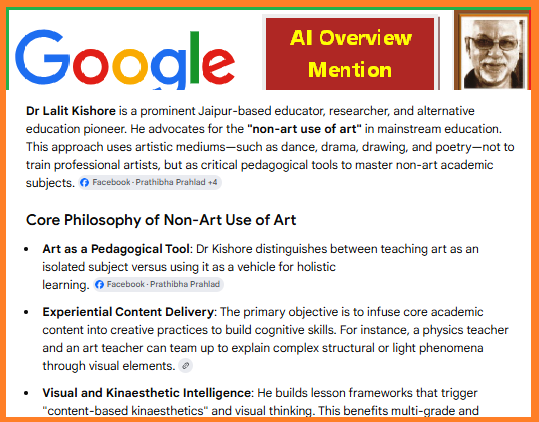
The concept of "non-art use of art" in STEM education refers to the method of utilizing visual artistic mediums not to train professional artists, but as a vital pedagogical tool for mastering non-art academic subjects. This approach serves as a vehicle for contextual art-integrated learning.. The primary objective is to infuse core academic content into creative practices to build cognitive and problem solving skills. For instance, a subject teacher can use to explain academic concepts or curricular topics through visual elements for active engagement of students in learning.
In summary
Kishore (2026) explores an innovative pedagogical method that repurposes everyday smartphones into active tools for experiential STEM learning. Instead of treating mobile photography purely as a tool for creative or artistic expression, he advocates for its application as a precise, non-artistic visual medium for reflecting on visual data.
Kishore, L. (2026, June 13), sing mobile photography of shift-and-tilt as non-artistic visual medium for STEM education, Lalit Culp https://lalitculp.wixsite.com/website/post/using-mobile-photography-shift-and-tilt-as-non-artistic-visual-mediums-for-stem-education,


Comments